QuantEvolve: How LLM Multi-Agents 'Evolve' Quant Strategies
The quant version of AlphaEvolve. A paper review of QuantEvolve — a framework that auto-generates and evolves trading strategies using LLM multi-agents + evolutionary algorithms.
If AlphaEvolve solved math problems, QuantEvolve evolves trading strategies. Presented as an oral paper at ACM ICAIF 2025, this paper proposes a framework that automatically generates quant strategies using LLM multi-agents + evolutionary algorithms.
The Problem: Why Existing Approaches Fall Short
Existing LLM-based quant systems (AlphaGPT, R&D-Agent-Quant, etc.) focus on alpha factor discovery. They're good at finding individual signals, but can't build complete strategies (end-to-end) that include position sizing, risk management, and execution logic. Plus, chasing a single "optimal strategy" makes you vulnerable to market regime changes.
Core Ideas of QuantEvolve
1. Quality-Diversity Evolution: Feature Map

Figure 1: QuantEvolve Framework Architecture
Instead of optimizing strategies with a single objective function, QuantEvolve places them on a Feature Map — a multi-dimensional grid. Each dimension maps to investor preferences:
- Strategy Category (momentum, mean reversion, arbitrage, etc. — binary encoding)
- Sharpe Ratio (risk-adjusted returns)
- Maximum Drawdown (MDD)
- Trading Frequency
- Cumulative Returns
Each cell stores only the single best strategy for that combination of characteristics. This lets diverse risk-return profiles coexist and prevents mode collapse.
2. Island Model: Balancing Exploration and Convergence

Figure 3: Strategy Exchange Between Islands
Multiple "islands" evolve strategies independently, periodically migrating the top 10% to neighboring islands. Early on, each island deep-dives into specialized strategies (momentum, mean reversion, etc.). Later, cross-pollination produces hybrid strategies.
3. Hypothesis-Driven Multi-Agent System

Figure 2: Multi-Agent Evolution Architecture
Strategy generation runs through a 3-stage agent pipeline:
- Research Agent — Analyzes parent + cousin strategies → generates new hypotheses (grounded in finance theory)
- Coding Team — Implements hypotheses in Python → Zipline backtest → iterative debugging
- Evaluation Team — Analyzes hypothesis, code, and results → extracts insights → passes to future generations
The key is insight accumulation. Failed approaches (30+) are documented with why they failed, preventing the same mistakes. Far more efficient than pure random mutation.
4. Parent-Cousin Sampling
When creating new strategies, the system selects 1 parent + 7 cousins from the Feature Map:
- Best Cousins (2): high-performance strategies
- Diverse Cousins (3): strategies adjacent to the parent in Feature Space
- Random Cousins (2): random selection
This structure achieves exploitation (inheriting high performance) and exploration (discovering new combinations) simultaneously.
Results
Equities (AAPL, MSFT, AMZN, GOOGL, META, NVDA)
The evolution process is impressive:

Figure 7: Evolution of Optimal Strategy in Equity Markets
- Gen 0: Volume-momentum signal (simple)
- Gen 10: Multi-timeframe momentum + volatility filtering → returns↑ drawdown↑
- Gen 40: Portfolio-level volatility monitoring introduced → drawdown↓
- Gen 80: Cointegration pair trading attempt → failed (cointegration unstable during volatile periods)
- Gen 130: Selective integration of past successes → momentum entry + volatility scaling + trailing stop
The final strategy outperforms all baselines: MarketCap, Equal Weight, Risk Parity, RSI, and MACD.
Futures (ES, NQ)

Figure 9: Strategy Evolution in Futures Markets
- Gen 0: Fixed Bollinger Band mean reversion → SR -1.21 (disaster)
- Gen 10: Adaptive Z-score + momentum confirmation → MDD improved to -15%
- Gen 20: Dual-mode regime detection — low volatility → mean reversion, high volatility → momentum following
- SR 1.03 | CR 37.4% | MDD -15.4%
- Beats both ES (SR 0.66) and NQ (SR 0.97) buy-and-hold
Interestingly, generations after Gen 20 built more complex systems, but generalization performance actually declined. A textbook case of simplicity beating sophistication — the classic bias-variance tradeoff.
Feature Map Evolution

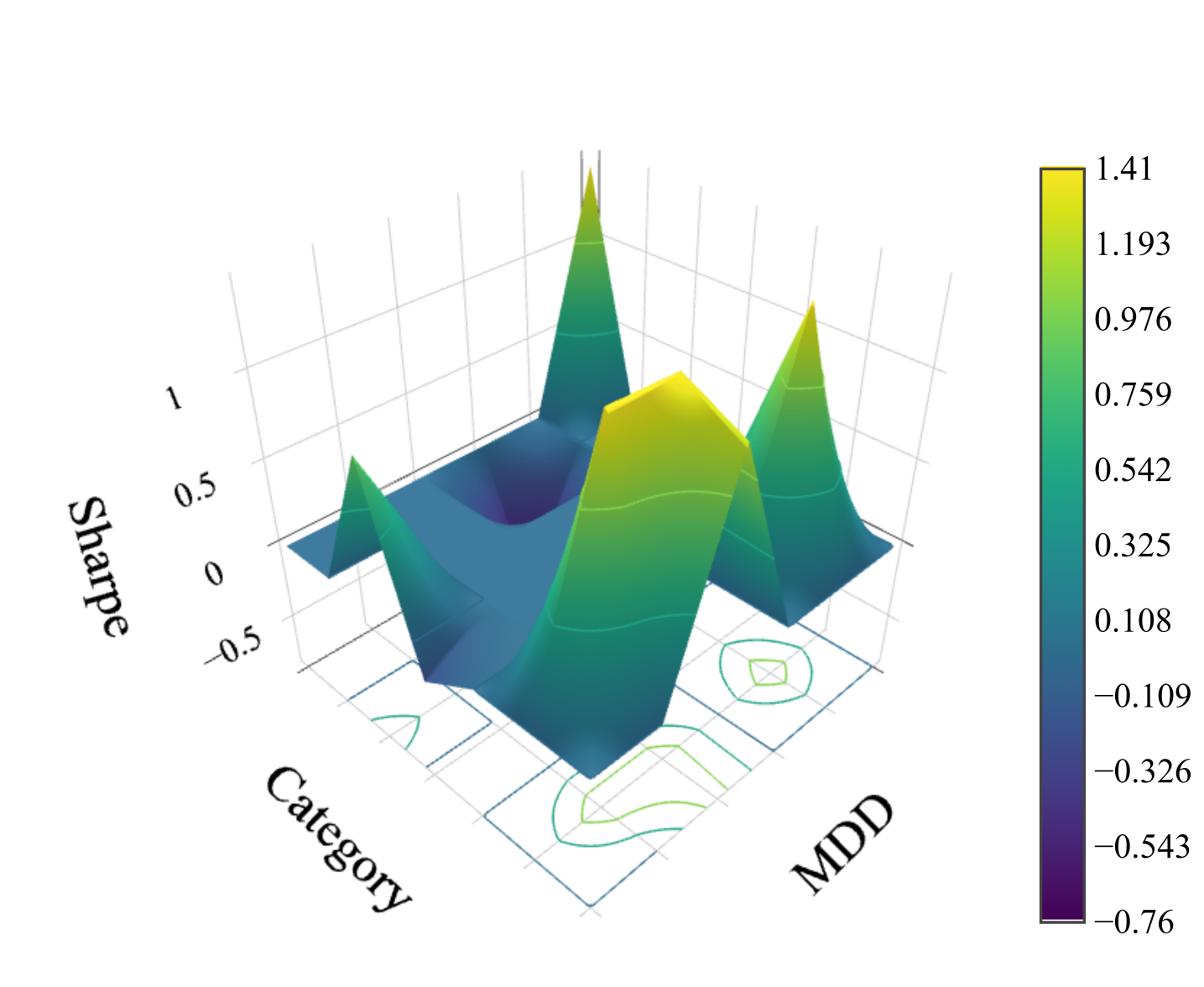
Figure 5: Feature Map Evolution by Generation (MDD × Category dimension, Sharpe Ratio)
The nearly empty Feature Map at Gen 0 gradually fills through Gen 150, with each cell's performance steadily improving.
Insight Evolution

Figure 8: Insight Evolution in Equity Markets
The real value of this framework may lie not in the strategies themselves but in the accumulated insights:
- "Simple volatility indicators fail during crises" → need VIX + moving average combination
- "Volatility thresholds should be calculated per-asset, not portfolio-wide"
- "Regime detection failures stem from volatility annualization errors (the logic itself is valid)"
- 30+ failed approaches documented → future generations avoid the same traps
Tech Stack
- LLM: Qwen3-30B-A3B (fast responses) + Qwen3-Next-80B-A3B (deep analysis) ensemble
- Backtesting: Zipline Reloaded + QuantStats
- Evolution Score: Score = Sharpe Ratio + Information Ratio + MDD (equal weight)
Limitations and Open Questions
- Small data universe — only 6 stocks and 2 futures. Scaling to hundreds of instruments is the real challenge
- Overfitting risk — the paper itself reports performance degradation when complexity increases after Gen 20
- No execution costs — Zipline simulations don't capture real slippage and market impact
- LLM costs — 150 generations × multi-agent = significant API costs (exact figures not disclosed)
Takeaways
QuantEvolve is one of the most concrete implementations of the vision "AI invents trading strategies." Key insights:
- Paradigm shift: from pursuing a single optimal strategy → maintaining a diverse strategy pool
- Value of failure documentation — 30+ failed approaches dramatically improve future search efficiency
- Simplicity wins — moderately complex mid-generation strategies generalize better than complex late-generation ones
A must-read for anyone looking to leverage LLMs in quantitative trading.
Paper: QuantEvolve: Automating Quantitative Strategy Discovery through Multi-Agent Evolutionary Framework
Authors: Junhyeog Yun, Hyoun Jun Lee, Insu Jeon
Presented at: ACM ICAIF 2025 (AI4F Workshop, Oral Presentation)